
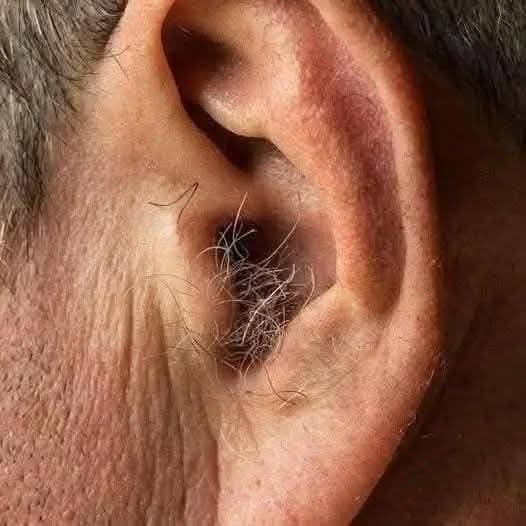
Even without any underlying health issues, ear hair is strongly associated with the natural process of aging. As the body gets older, several things happen simultaneously that make ear hair more likely and more visible.
Hormone levels shift and fluctuate. Hair follicles throughout the body change their sensitivity and behavior in response to those shifting hormones. Vellus hair follicles — which have been quietly producing fine, invisible peach fuzz for decades — begin transitioning into terminal hair follicles, producing thicker and more visible strands.
Additionally, the growth cycle of individual hair strands changes with age. Younger hair follicles have a precisely regulated cycle of growth, rest, and shedding. As the body ages, this regulation becomes less precise — follicles in the ears and nose can enter extended growth phases, causing the hairs to grow longer before they naturally fall out. The result is the kind of noticeably long, wiry ear hair that seems to appear out of nowhere after a certain age.
Your body is telling you: you are getting older, and your follicles know it. This is natural and completely normal — but it is also a reminder that regular health monitoring becomes more important as you age.
4. 🧬 Your Genetics Are Expressing Themselves
Ear hair has a strong hereditary component. If your father, grandfather, or other male relatives on either side of your family had noticeable ear hair, the probability is high that you will develop it too — often at a similar age and in a similar pattern. This is because the sensitivity of individual hair follicles to hormones like testosterone and DHT is largely determined by inherited genetic programming.
Certain ethnic backgrounds also show a higher tendency toward ear hair growth. Research has consistently noted a particularly high prevalence of ear hair — especially the thick, coarse variety growing along the lower rim of the ear — in South Asian male populations. This is a genetic characteristic, not a health problem.
Your body is telling you: your ancestral genetics are manifesting in your physical characteristics. This is not something to worry about — but if your family history also includes heart disease or hormonal conditions, that context adds significance to the earlier point about cardiovascular health awareness.
5. 🩺 In Rare Cases — A Signal of an Underlying Condition
While the vast majority of ear hair is normal and harmless, there are some specific situations where increased ear hair growth can signal something that deserves medical attention.
Some studies have suggested a connection between excessive ear hair and certain hormonal disorders. In a small number of cases, a sudden significant increase in ear hair — particularly if it appears rapidly or is accompanied by other changes such as increased body hair elsewhere, acne, or voice changes — could indicate a hormonal imbalance worth investigating.
In rare cases, excessive hair growth in unusual locations has been associated with certain medications, particularly those that affect androgen levels. Babies born to women with poorly controlled diabetes during pregnancy have also been noted to sometimes have increased ear hair at birth — a characteristic that tends to resolve as the child grows and the effects of the maternal hormonal environment diminish.
Additionally, some research has noted a connection between significant increases in ear hair and HIV in certain cases, though this connection is rare and not a reliable diagnostic indicator.
Your body is telling you: if the ear hair appeared suddenly and dramatically, or is accompanied by other unexplained physical changes, a conversation with your doctor is worthwhile.
The Purpose Ear Hair Actually Serves
Before you rush to remove every strand, it is worth understanding that ear hair exists for a reason. The body does not grow hair in locations without purpose.
Terminal hair in and around the ear canal works in partnership with the ear’s natural wax to form a protective barrier against the outside world. This barrier traps dust, debris, insects, bacteria, and other particles before they can travel deeper into the ear canal and potentially damage the eardrum. In this way, ear hair functions similarly to nose hair — as a biological filter protecting a sensitive internal structure.
Inside the ear canal, there are also microscopic sensory hair cells — entirely different from the hair we are discussing — that play a critical role in both hearing and balance. These tiny sensory cells bend in response to sound waves and fluid movement, sending signals to the brain that allow you to hear and know where your body is in space.
The outer ear hair that grows visibly is the protective kind — and some amount of it is genuinely beneficial. It only becomes a concern when it grows excessively enough to potentially trap water and bacteria, increasing the risk of outer ear infections known as swimmer’s ear.
When to See a Doctor
In the vast majority of cases, ear hair is harmless and requires no medical attention. However, consider speaking to a doctor if:
Ear hair appeared suddenly and increased dramatically in a short period of time
You are relatively young — in your 30s or early 40s — and noticing significant ear hair for the first time, especially with a family history of heart disease
The ear hair is accompanied by other unexplained changes such as rapid hair growth elsewhere on the body, acne, voice changes, or unexplained weight changes
You experience ear discomfort, pain, or hearing changes alongside increased hair growth
You have risk factors for cardiovascular disease and want to use this as a prompt to get a checkup
How to Remove Ear Hair Safely
If you decide you want to remove ear hair for cosmetic reasons, there are several safe and effective options:
Trimming is the easiest and most comfortable option. A dedicated ear and nose hair trimmer with a rounded, safe tip removes protruding hair without risk of cutting the skin. Results last one to two weeks.
Plucking removes hair from the root using tweezers, giving results that last one to eight weeks. It is effective but can be uncomfortable, and should only be used on the outer ear — never inside the ear canal.
Waxing removes larger amounts of hair at once and keeps the ears smooth for two to eight weeks. It should only be performed on the outer ear and earlobe by a careful hand.
Laser hair removal targets and destroys individual hair follicles using heat, providing permanent reduction after multiple sessions. It is the most expensive option but the most long-lasting, and it is safe when performed by a qualified professional on the outer ear.
Important: Never insert sharp objects, cotton swabs, or any removal tool deep into the ear canal. The canal and eardrum are extremely delicate, and internal injury can cause serious damage including hearing loss. Only the outer, visible ear and earlobe should be treated with hair removal methods.
The Bottom Line
Hair growing on your ears is, in most cases, your body’s natural response to aging, hormonal shifts, and genetic programming. It is a completely normal part of life for the majority of men — and for many women too, though less commonly.
But it is also a conversation your body is having with you. It is telling you that your hormones are changing, that your follicles are responding differently than they once did, and — in some cases — that a cardiovascular checkup might be worthwhile. That information is genuinely valuable.
Listen to your body. Understand what it is telling you. And share this with someone who has been wondering about the same thing.
