
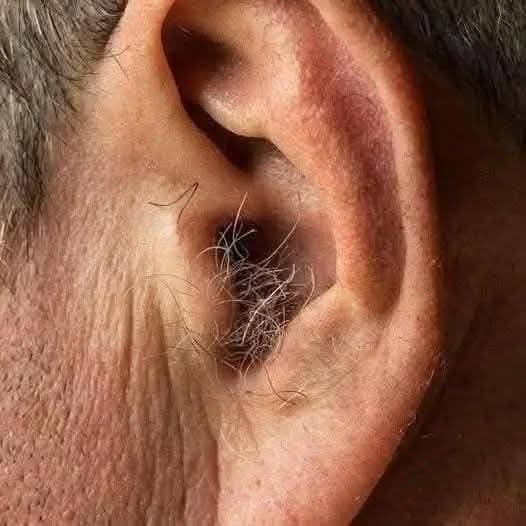
You notice it one morning — a few wiry, dark hairs curling around your earlobe or poking out of the ear canal. It seems strange, maybe even alarming. But your body is communicating something important, and understanding what it means can genuinely change how you manage your health.
Ear hair is one of those things nobody talks about openly, yet almost everyone encounters at some point in their life — especially men as they get older. It can appear suddenly, grow surprisingly fast, and feel like something is wrong. But in most cases, it is a completely natural part of how the human body works. In some cases, however, it can be an early signal worth paying closer attention to.
Here is the full, honest picture of what it means when hair starts growing on your ears — and what your body may actually be telling you.
First: What Is Ear Hair Exactly?
Not all ear hair is the same. There are two distinct types, and understanding which one you are dealing with matters.
Vellus hair is the fine, soft, colorless “peach fuzz” that covers most of the body’s surface, including the outer ear. Almost everyone has this — it lies flat against the skin, is barely visible, and plays a role in regulating body temperature. This type of ear hair is completely normal at any age and is almost never a cause for concern.
Terminal hair is the thicker, darker, stiffer type of hair — similar to what grows on the scalp, eyebrows, and armpits. When people talk about ear hair as a concern, this is almost always what they mean. Terminal hair on and around the ears tends to stand upright, grow noticeably longer, and can protrude from the ear canal in visible tufts. This type increases significantly with age, particularly in men.
The medical term for excessive hair growth on or in the outer ear is auricular hypertrichosis. It does not affect hearing and is in most cases a cosmetic issue — but it can sometimes signal something your body needs you to pay attention to.
What Your Body Is Telling You: The Real Reasons Hair Grows on Your Ears
1. 🧬 Your Hormones Are Shifting — Especially Testosterone
The most well-established and scientifically supported explanation for ear hair — particularly when it becomes more noticeable in middle age and beyond — is hormonal change, specifically involving androgens like testosterone and its byproduct dihydrotestosterone (DHT).
As men age, the hair follicles inside and around the ears become increasingly sensitive to testosterone. Even when overall testosterone levels remain stable or begin to decline with age, these follicles become hyperresponsive — reacting more strongly than they did in earlier decades. The result is that follicles that previously produced only fine vellus hair begin converting to terminal hair production, growing thicker, darker, and longer strands.
This same process, driven by DHT, creates what scientists call the “androgen paradox” — the same hormone that causes the hair follicles on the top of the head to shrink and eventually stop producing hair is simultaneously causing the follicles in the ears, nose, and eyebrows to become overactive and produce more visible hair. This is why men who are experiencing hair loss on their scalp often simultaneously notice increasing hair in their ears and nose.
Your body is telling you: your hormonal landscape is changing. This is a completely natural part of aging for most men — but it is worth being aware of, because those same hormonal shifts have implications for other aspects of health.
2. ❤️ A Potential Early Warning Sign for Heart Health
This is the connection that surprises most people — and it is one worth taking seriously.
Multiple scientific studies have explored a correlation between ear hair growth — particularly thick, dark hair growing along the earlobe and the outer rim of the ear — and an increased risk of coronary artery disease. The link is not fully understood, but researchers believe it may be connected to the same elevated androgen levels that drive ear hair growth.
People with higher testosterone and DHT levels are more likely to develop body hair including in the ears. Scientific research has established that people with greater amounts of testosterone also face a higher statistical risk of developing heart disease. Interestingly, studies have found this correlation to be particularly significant in younger age groups — meaning that early-onset ear hair in a man in his 30s or 40s may carry more significance as a health signal than the same hair in a man in his 70s.
The connection between ear hair and heart disease is not a diagnosis — it is a statistical association. Having ear hair does not mean you have heart disease. But if you are noticing increasing ear hair, particularly at a younger age, it is a reasonable prompt to schedule a cardiovascular checkup, check your cholesterol and blood pressure, and discuss your heart health risk factors with a doctor. Used as an early warning signal, ear hair growth can encourage preventive action at a stage when intervention is most effective.
3. 👴 Your Body Is Aging — And the Follicles Are Responding
NEXT PAGE
