
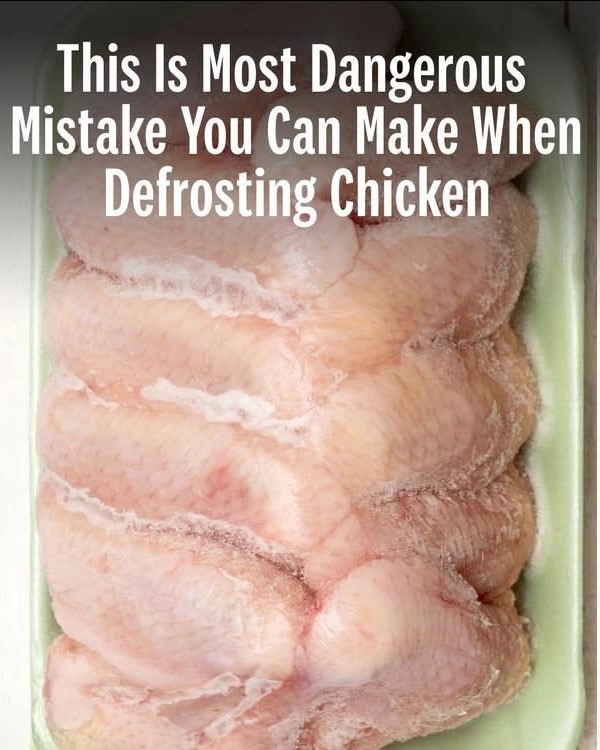
Almost every home cook has done it. Almost nobody realizes just how dangerous it actually is. Here is the truth about defrosting chicken — and everything you need to know to do it safely.
It is one of the most common scenes in kitchens everywhere. You forget to take the chicken out of the freezer the night before. Dinner time is approaching fast. So you do what feels like the most logical thing — you set the frozen chicken on the counter and let it thaw at room temperature while you go about your day.
It seems harmless. Millions of people do it every single day. But food safety experts and the world’s leading health authorities are unanimous: leaving chicken to defrost on the counter is one of the most dangerous food preparation mistakes you can make — and it is responsible for a significant portion of the foodborne illness cases that send people to the hospital every year.
Here is why it is so dangerous, what actually happens to your chicken while it sits on that counter, and — most importantly — exactly what to do instead.
The Danger Zone: What Is Happening to Your Chicken on the Counter
To understand why counter defrosting is dangerous, you need to understand one critical concept in food safety: the Danger Zone.
Harmful bacteria — the kind that cause serious foodborne illnesses including salmonella, campylobacter, listeria, and E. coli — do not grow at a steady, predictable pace. They grow exponentially, doubling in number every 20 minutes under the right conditions. And the right conditions are temperatures between 4°C and 60°C (40°F and 140°F) — a range that food safety authorities call the Danger Zone.
Raw chicken left at room temperature — which in most kitchens sits somewhere between 18°C and 24°C (65°F to 75°F) — falls squarely in the middle of that Danger Zone. And the problem with frozen chicken thawing on a counter is that it does not thaw evenly or all at once.
The outer surface of the chicken — the skin, the edges, the thinner parts — thaw first and reach room temperature long before the center of the meat has even begun to soften. This means that the outer layers of your chicken can sit in the Danger Zone for hours while the interior is still frozen solid. During those hours, bacteria on the surface can multiply from a few hundred cells to hundreds of millions — numbers high enough to cause serious illness even if the chicken is subsequently cooked to a safe internal temperature.
Cooking the chicken will kill most live bacteria — but it will not destroy the toxins that certain bacteria, like Staphylococcus aureus, have already produced during those hours of warm-temperature growth. Those toxins remain in the meat even after thorough cooking and are a direct cause of food poisoning.
The rule food safety authorities agree on universally is this: if chicken has been sitting at room temperature for more than two hours, it should not be eaten. The risk of illness is too high.
The Most Dangerous Defrosting Mistakes — And Why People Keep Making Them
❌ Mistake 1: Leaving Chicken on the Kitchen Counter
This is the number one defrosting mistake — and the most dangerous. As explained above, counter defrosting creates the perfect conditions for bacterial growth. The exterior reaches room temperature while the interior remains frozen, creating hours of dangerous exposure in the Danger Zone.
The fact that the chicken still looks and smells perfectly fine after thawing on the counter makes this mistake particularly insidious. Dangerous levels of bacteria produce no visible signs, no unusual smell, and no change in color or texture. The chicken can look completely normal and still contain enough bacteria to cause serious illness.
This mistake is especially dangerous in warm kitchens, during summer months, or in climates where room temperature regularly exceeds 25°C — conditions that accelerate bacterial growth even further.
❌ Mistake 2: Defrosting in Hot Water
Many people, knowing that the counter is not ideal, try to speed things up by placing frozen chicken in a bowl of hot water. This is arguably even more dangerous than counter defrosting.
Hot water rapidly pushes the exterior of the chicken into the upper end of the Danger Zone — temperatures where bacterial growth is fastest. It can also partially cook the outer layers of the chicken while the interior remains frozen, creating uneven texture and compromising the final quality of the meat. The result is chicken that is simultaneously over-cooked on the outside and potentially still dangerously undercooked in the center.
❌ Mistake 3: Defrosting in the Microwave and Then Waiting to Cook
Using the microwave’s defrost setting is a legitimate and officially recognized safe method for thawing chicken — but only if the chicken is cooked immediately afterward. Many people use the microwave to partially defrost chicken and then set it aside for an hour or more before cooking, thinking they have done the right thing. This is a serious mistake.
Microwave defrosting heats some parts of the chicken significantly while others remain cold. Any portion of the chicken that was warmed above 4°C during microwave defrosting must be cooked immediately to prevent bacteria from multiplying in those already-warmed areas.
❌ Mistake 4: Leaving Chicken in an Open Bowl of Water in the Sink
Some people place frozen chicken in an open bowl of water in the sink to thaw. This creates two problems simultaneously. First, if the water is not kept cold — changed regularly and maintained below 4°C — it becomes a warm-water bath that sits in the Danger Zone. Second, raw chicken juices dripping and splashing in an open container can contaminate the entire sink area with bacteria, creating a cross-contamination risk that extends far beyond the chicken itself.
❌ Mistake 5: Refreezing Improperly Defrosted Chicken
If chicken has been defrosted using an unsafe method — particularly counter defrosting — and then refrozen without being cooked, the bacterial contamination that developed during the unsafe thaw is locked back into the frozen meat. When the chicken is thawed again, those bacteria pick up exactly where they left off. Refreezing improperly thawed chicken does not reset the bacterial clock — it just pauses it.
❌ Mistake 6: Neglecting to Clean Surfaces After Raw Chicken Contact
Raw chicken — whether frozen, thawing, or fully defrosted — can leave bacteria on every surface it contacts: cutting boards, countertops, plates, utensils, your hands, and anything those surfaces subsequently touch. Failing to sanitize these surfaces after handling raw chicken is one of the most common causes of cross-contamination foodborne illness, where bacteria spread from the raw meat to cooked food, salads, fruit, or other items that will not be heated before eating.
The 4 Safe Ways to Defrost Chicken
The good news is that defrosting chicken safely is not difficult or complicated. It simply requires choosing the right method for the time you have available.
✅ Method 1: In the Refrigerator — The Safest Method of All
