
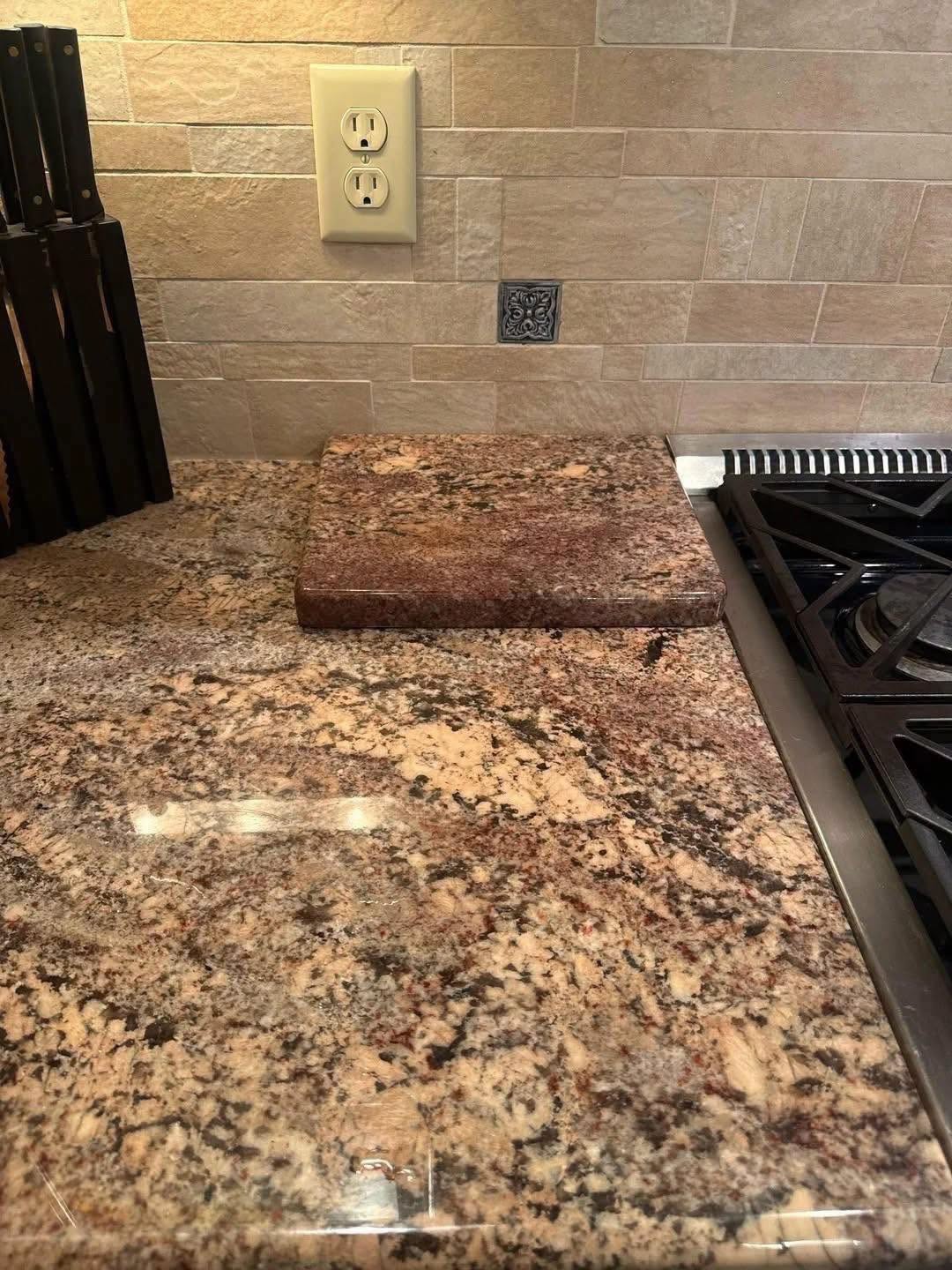
You’re rearranging your kitchen cabinets or moving into an older home, and you spot it — a smooth, polished rectangle of granite tucked next to the stovetop or set into the countertop surface. No label. No obvious purpose. It doesn’t quite match the surrounding counter. It takes up prep space. And it looks exactly like a cutting board someone forgot to put away — except it’s completely fixed in place and clearly intentional.
If you’re under 50, you probably stared at it and thought: “What on earth is this for?”
If you’re a Baby Boomer or Gen Xer, you likely smiled with immediate recognition. Because you know exactly what it is — and you know why it matters.
It’s a Built-In Countertop Heat Pad — and It Was Brilliant
That slab of granite isn’t a design mistake, an unfinished installation, or a misplaced pastry board. It’s a built-in heat pad — a deliberate, clever kitchen design feature that was considered a premium upgrade during the late 1980s and throughout the 1990s.
Its purpose was simple and practical: to provide a heat-safe landing zone for scalding pots, pans, and baking dishes coming straight off the stove or out of the oven, without damaging the surrounding countertop surface.
To understand why this mattered so much, you have to look at what kitchens were made of before granite became the standard.
The Countertop Crisis That Made Granite Slabs Necessary
Before granite became the dominant material in American and European kitchens, the vast majority of homes featured Formica or laminate countertops. Laminate was affordable, widely available, and came in an enormous range of colors and patterns — but it had one critical and irreparable flaw.
It absolutely could not handle heat.
Placing a pot of boiling water, a cast-iron skillet straight from the burner, or a baking dish fresh from a 400°F oven directly onto a laminate countertop would instantly scorch and melt the surface, leaving behind a permanent, disfiguring brown ring. There was no fixing it — only replacing the entire countertop section, which was expensive and disruptive.
As custom kitchen design became more aspirational during the Boomer era, clever builders came up with an elegant solution. Rather than replace the entire countertop in stone, they would cut out a section of the laminate right next to the range or stovetop — exactly where hot items would most naturally be set down — and drop in a thick, raised piece of polished granite, quartz, or marble.
The result was a dedicated heat buffer built directly into the kitchen. A permanent, indestructible landing pad that could handle anything coming off the stove without a second thought.
Where the Granite Came From
Here’s a detail that makes this story even more satisfying: most of these heat pads weren’t made from freshly quarried stone ordered specifically for the purpose.
When granite countertops were being fabricated and installed — particularly during sink cutouts, edge trimming, and custom shaping — the fabricators were left with substantial leftover pieces. Rather than discard these remnants, many countertop companies and contractors began repurposing them as heat pad inserts.
It was resourceful, practical, and cost-effective. The leftover stone that would otherwise have been thrown away became a functional upgrade that homeowners valued and protected. The slightly mismatched look that puzzles younger homeowners today is often simply because the heat pad was made from a different batch or cut of stone than the rest of the countertop — a minor visual inconsistency that was entirely acceptable given the practical benefit.
Why Granite Was the Perfect Material for This Job
