
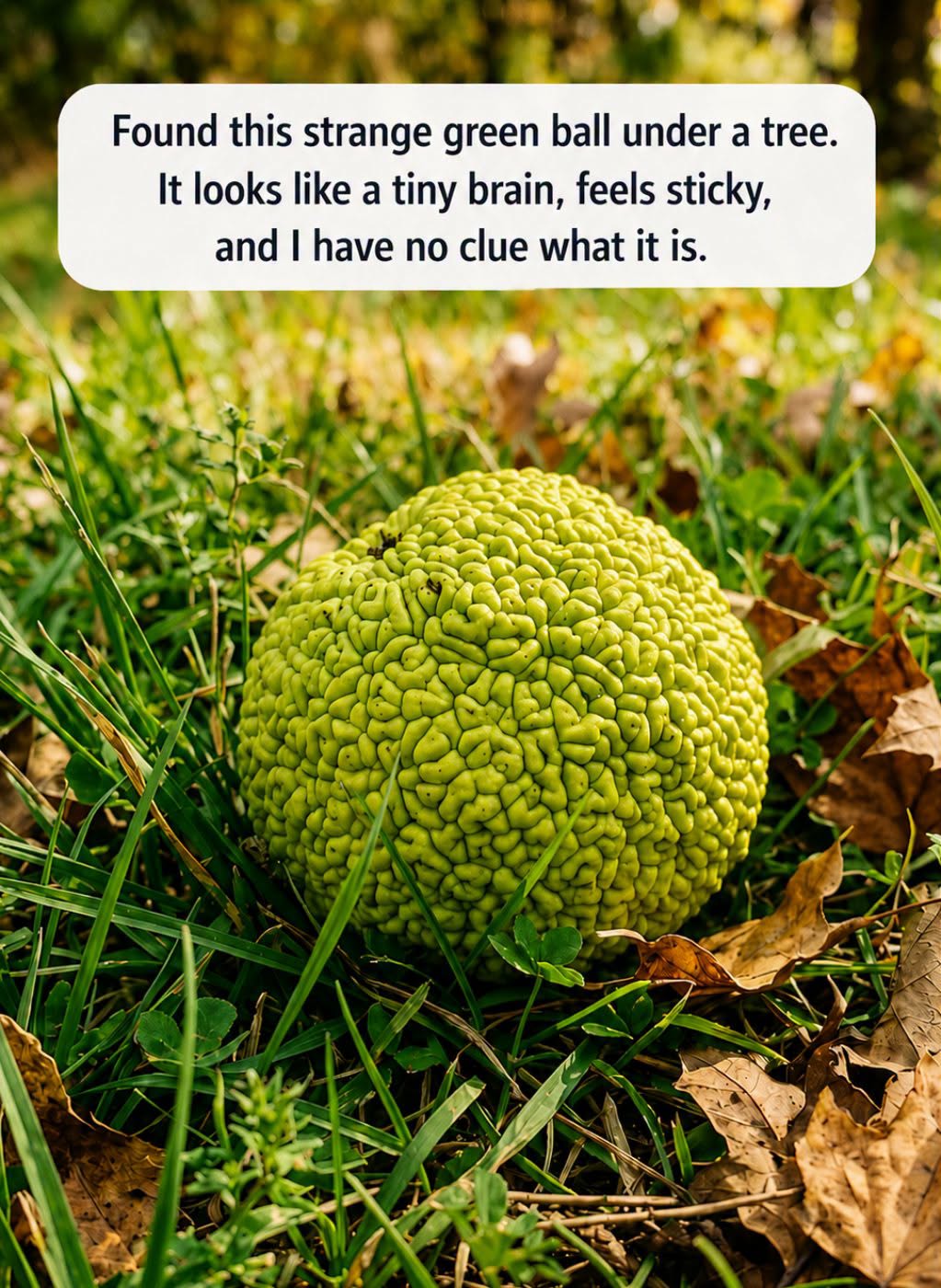
Here is where the story of the Osage orange becomes genuinely extraordinary.
If you look at the fruit and try to imagine what animal would eat something that large, that heavy, and that unappetizing — you won’t find the answer in any modern North American ecosystem. No native animal regularly eats or disperses Osage orange fruits. Squirrels will sometimes tear them open to reach the seeds inside, but they don’t carry them far. Deer may occasionally nibble at fallen fruits but don’t consume them in any meaningful quantity. Even horses, despite the “horse apple” nickname, largely ignore them.
The mystery of why this fruit exists in its current form — why a tree would produce something so large and energetically expensive that nothing eats it — led botanists and evolutionary biologists to a remarkable conclusion.
The Osage orange fruit almost certainly evolved to be eaten and dispersed by animals that no longer exist. Specifically, the giant megafauna of the Pleistocene epoch — woolly mammoths, mastodons, giant ground sloths, and possibly horses and camels native to North America — which went extinct approximately 10,000 to 13,000 years ago. These enormous animals would have been perfectly capable of consuming and dispersing a fruit of this size, swallowing it whole and depositing the seeds far from the parent tree through their digestive process.
With those animals gone, the Osage orange lost its primary seed dispersers virtually overnight in evolutionary terms. The fruit it produces is essentially a message in a bottle — an evolutionary adaptation designed for a world that no longer exists, still faithfully produced each autumn for animals that vanished millennia ago.
Scientists call this phenomenon an evolutionary anachronism, or a “ghost of evolution.” The Osage orange is one of the most striking examples of this concept in the natural world — a tree still waiting, in a sense, for the return of the giants that were supposed to carry its seeds.
The Tree That Helped Settle America
Despite producing fruit that almost nothing wants to eat, the Osage orange tree itself played a surprisingly significant role in American history — and the reason comes down entirely to its extraordinary wood.
Osage orange wood is among the hardest, densest, and most rot-resistant hardwoods in North America. It resists decay for decades even when in direct contact with soil and moisture. It burns slowly and intensely, producing more heat per cord than almost any other North American wood. And it is remarkably flexible — strong enough to absorb tremendous stress without breaking.
Native American tribes across the Great Plains recognized this long before European settlers arrived. The Osage, Comanche, and many other nations prized the wood above all others for crafting bows — the most essential and technologically sophisticated tool of Plains warfare and hunting. A well-made Osage orange bow was considered one of the finest weapons available anywhere in the pre-contact Americas, and the wood was actively traded across vast distances. The French name bois d’arc — wood of the bow — preserves this history directly.
When European settlers began pushing across the Great Plains in the 19th century, they faced a critical challenge: the prairie had no natural fences and no easily available fencing timber. The Osage orange provided the solution. Its combination of thorny branches and dense, rot-resistant wood made it ideal for living fence hedgerows. Trees could be planted closely together in rows, and within a few years their interlocking thorny branches formed a barrier that was famously described as “horse high, bull strong, and pig tight” — strong enough to contain virtually any livestock.
By the 1850s, Osage orange hedgerows were being used to fence entire farms across Illinois, Missouri, Kansas, and beyond. The invention of barbed wire in 1874 eventually replaced the living hedge — but the fence post cut from Osage orange wood remained the preferred choice for generations of farmers, lasting 50 to 80 years in the ground without treatment.
During the 1930s Dust Bowl crisis, President Franklin D. Roosevelt’s administration planted over 200 million Osage orange trees as part of a massive shelterbelt project designed to break the wind, prevent soil erosion, and restore ecological stability to the devastated Great Plains. Trees planted during that era are still standing across the Midwest today.
Does the Osage Orange Repel Insects?
One of the most widespread folk beliefs about hedge apples is that placing them in the home repels spiders, cockroaches, boxelder bugs, and other insects. This claim has circulated for generations and has spawned a small cottage industry of people selling hedge apples at roadside stands each fall specifically for this purpose.
The reality is more nuanced. Laboratory research has confirmed that chemical compounds extracted from Osage orange fruits — including several unique isoflavonoids and other bioactive substances — do have insect-repellent properties in concentrated form.
However, the key word is concentrated. The concentrations of these compounds in a whole, intact fruit sitting in the corner of a room are far too low to produce any meaningful insect-repelling effect in a real-world home environment. The studies that demonstrated repellent activity used extracted and concentrated compounds — not whole fruits casually placed near a baseboard.
The practical consensus among entomologists is clear: whole hedge apples placed around the home are unlikely to meaningfully reduce insect presence. If they appear to work, the most likely explanation is coincidence or the normal seasonal decline in insect activity that happens regardless of what you place in your living room.
Is the Osage Orange Dangerous or Toxic?
The short answer is no — not seriously. The milky latex sap that the fruit secretes when cut can cause mild skin irritation in some people, particularly those with sensitive skin or latex sensitivities. It’s advisable to wear gloves when handling cut fruit. The latex can also cause temporary staining on surfaces and fabric.
The fruit itself is not toxic, but it is not considered edible by humans in any practical sense. The seeds inside are technically edible — they contain oil and protein — but extracting them from the dense, fibrous pulp requires significant effort for very little reward.
The tree’s thorns deserve respect. They are sharp, rigid, and long enough to cause real puncture injuries. Take care when working near or under an Osage orange tree.
What Can You Do With Hedge Apples?
Despite being largely inedible and of questionable value as an insect repellent, Osage orange fruits have several genuinely useful and enjoyable applications:
Autumn decoration: Their vivid chartreuse color and unusual texture make them genuinely striking decorative objects. A bowl of hedge apples on a fall table creates an instant conversation piece and holds up well for several weeks before beginning to shrivel.
Crafts and projects: The dried fruit can be used in seasonal wreaths, natural centerpieces, and various craft projects. The distinctive brain-like texture photographs beautifully.
Firewood: Osage orange wood is among the most calorie-dense firewood available in North America. If you have access to cut wood from a hedge apple tree, it is exceptional fuel.
Wildlife support: Leaving fallen fruits under the tree provides food for squirrels, which extract the seeds. In this small way, you are partially filling the ecological role once played by the Pleistocene megafauna.
Natural curiosity: Perhaps most valuably, finding an Osage orange is an invitation to one of the best nature stories available — a living connection to the Ice Age, to the great animals that shaped this continent, and to the long, strange arc of American history.
How to Identify the Osage Orange Tree
If you want to find the tree responsible for the fruit, look for these characteristics:
The bark is brown to orange-brown, deeply furrowed, and develops long, thin peeling ridges with age. Exposed roots and freshly cut wood are often strikingly bright orange — one of the most distinctive features of the species.
The branches are armed with stout, straight thorns approximately half an inch long, growing singly just above each leaf attachment point.
The leaves are simple, alternate, broadly oval, and glossy dark green on top with a paler underside. In autumn they turn a clear, pleasant yellow before dropping.
The tree typically has a short, dense trunk that branches relatively close to the ground into a broad, somewhat irregular crown.
In autumn, the ground beneath a female tree will be covered with the characteristic brain-like green fruits.
The Bottom Line
That weird green brain in your yard is one of the most historically significant, ecologically fascinating, and biologically unusual plants in North America. It is a living fossil from the Pleistocene, a tool of Native American craftsmen, a fence post that helped tame the Great Plains, a presidential conservation project, and a genuinely beautiful autumn curiosity all at once.
