
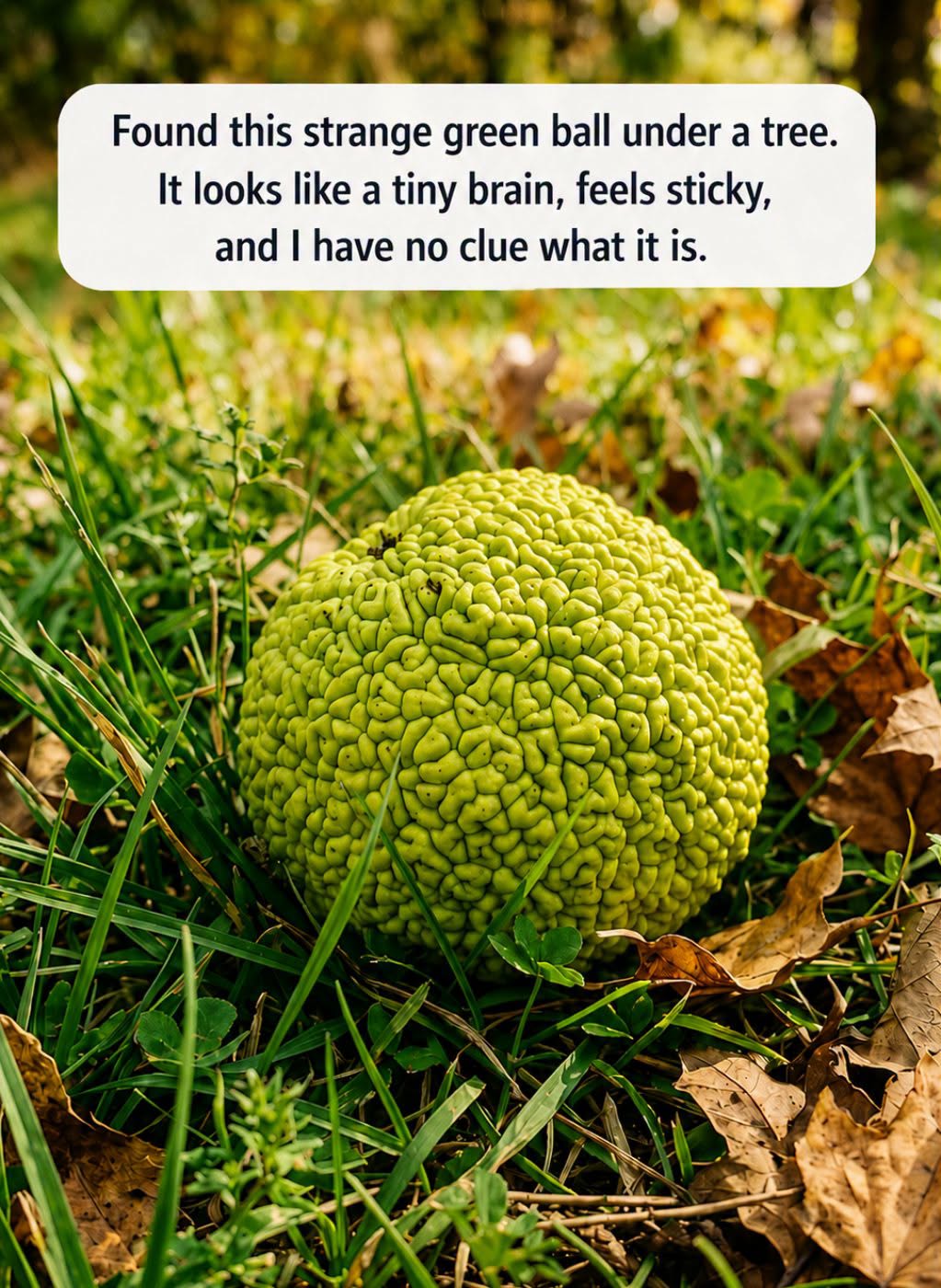
You’re walking through the yard, raking leaves, or just enjoying a fall afternoon — and then you nearly step on it. A large, round, bright green object sitting on the grass like it fell from another planet. It’s roughly the size of a softball. Its surface is bumpy, wrinkled, and deeply textured in a way that makes it look almost exactly like a human brain. It’s heavy. It smells faintly citrusy. And you have absolutely no idea what it is.
You are not alone. Every autumn, people across the United States encounter this same mysterious object for the first time and spend considerable time trying to figure out what on earth they’re looking at.
The answer is both simple and genuinely fascinating — and the story behind it stretches back millions of years.
What Is It? Meet the Osage Orange
That strange green brain-ball is the fruit of the Osage orange tree, known scientifically as Maclura pomifera. Despite its name, it is not related to oranges at all — it’s actually a member of the mulberry family, making it more closely related to figs and mulberries than to any citrus fruit.
Over the centuries, this peculiar fruit has accumulated an impressive collection of common names that reflect both its appearance and its history: hedge apple, horse apple, monkey brain, monkey ball, bois d’arc (from the French meaning “wood of the bow”), bodark, Irish snowball, and yellow wood. Any one of these names tells you something different about the plant and the people who encountered it.
The fruit itself is unmistakable. It grows to between four and five inches in diameter and can weigh up to three pounds. Its surface — covered in a mass of fused, seeded fruitlets pressed together to form a single large sphere — creates that distinctive brain-like texture that makes people stop and stare. When cut open, the interior reveals a thick, fibrous, woody pulp filled with small seeds, and a milky white latex sap that is sticky and slightly bitter. The taste has been described by those brave enough to try it as essentially inedible — somewhere between an air freshener and raw wood.
Where Does It Come From?
The Osage orange tree is native to a relatively small original range centered on central and northeastern Texas, Oklahoma, and Arkansas — the traditional territory of the Osage Nation, from which the tree takes its name. Today, however, it has been planted so widely across North America that it can be found in virtually every state in the continental United States and in parts of Canada.
The tree itself is a medium to large hardwood, typically growing between 30 and 50 feet tall, with a dense, irregular crown and a short, sturdy trunk. Its most immediately noticeable features are its stout, sharp thorns — which grow directly from the branches and can be half an inch long — and its bright, deeply grooved orange-brown bark that gives the wood its distinctive color.
The leaves are simple, glossy, and dark green on the upper surface. The fruit drops in autumn — September through November — and the ground beneath a mature Osage orange tree in fall can be thickly carpeted with dozens of these green brain-balls lying where they fell.
A Fruit From Another Era — The Evolutionary Ghost
