
[adinserter block=”3″]
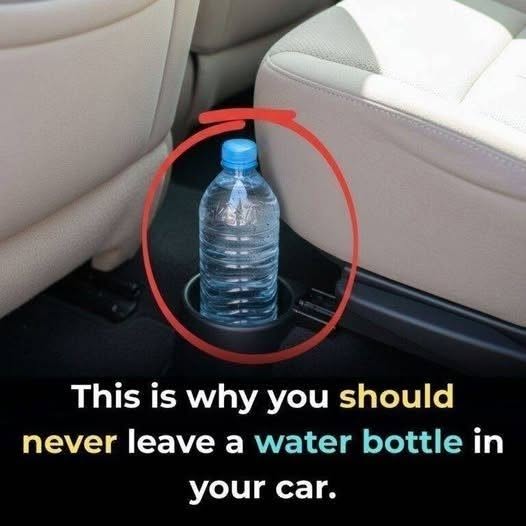
It seems completely harmless. You finish your drink, toss the water bottle on the seat, and forget about it until next time. Millions of people do exactly this every single day. But according to fire safety experts, biochemists, and medical researchers, leaving a plastic water bottle in your car — particularly on a hot, sunny day — is a habit worth reconsidering seriously.
There are two distinct dangers at play here, and both are more significant than most people realize.
Danger #1: Your Water Bottle Can Start a Fire
This is the one that shocks people the most — because it seems to violate basic logic. Water starts a fire? It sounds impossible.
But it’s real, it’s documented, and it has happened to drivers who had no idea the risk existed.
Here’s the science: a plastic water bottle filled with clear liquid behaves exactly like a magnifying glass. When sunlight passes through a car window and then through the curved surface of a full water bottle, the liquid and plastic work together to bend, concentrate, and focus the light into a single, intensely hot point — precisely the same way a magnifying glass concentrates sunlight to ignite a piece of paper.
A battery technician named Dioni Amuchastegui documented this terrifyingly well. Sitting in his truck during a lunch break, he noticed smoke in his peripheral vision. Looking over, he found that sunlight refracting through a water bottle on his seat had created a focused beam of light burning directly into the upholstery — scorching two visible holes in the fabric before he noticed and intervened. He measured the temperature at the focal point: 213°F. Hot enough to char fabric. Hot enough to start a fire.
He shared a video of the incident and the demonstration that followed, and it went viral for a simple reason: people couldn’t believe it was real until they saw it happen in real time.
Fire departments have since conducted independent tests confirming the danger. Vinyl car upholstery begins to burn at around 455°F. Getting from 213°F to ignition temperature doesn’t take long under sustained direct sunlight — particularly in a sealed vehicle where interior temperatures on a hot day can exceed 160°F within an hour.
The conditions that create the most risk are specific: a full or nearly full bottle, clear liquid, direct sunlight hitting the bottle at the right angle, and the focal point landing on a combustible surface like a seat, carpet, or paper. This combination doesn’t happen every time — but when it does, the results can be catastrophic.
Danger #2: Heat Causes Plastic Bottles to Leach Chemicals Into Your Water
This second danger is slower and less dramatic than a fire — but it affects far more people because it’s happening silently, invisibly, every time a plastic bottle sits in a hot car.
Plastic water bottles — particularly single-use disposable bottles made from polyethylene terephthalate, known as PET — are not designed to withstand sustained high heat. The molecules that make up the plastic begin to break down and migrate into the water they contain when exposed to elevated temperatures over time.
Research from Nanjing University found that PET plastic bottles exposed to temperatures of 158°F for an extended period released measurable quantities of antimony and bisphenol compounds into the water inside. Antimony is a heavy metal associated with headaches, dizziness, nausea, vomiting, sleep disturbance, lung inflammation, and stomach ulcers with prolonged exposure. Bisphenol compounds — including BPA and its chemical relatives — are endocrine-disrupting substances linked in research to increased cancer risk, fertility problems, cardiovascular disorders, and developmental concerns.
A car parked in direct summer sunlight can reach interior temperatures of 130°F to 160°F within 60 minutes — well within the range where chemical migration into water becomes a genuine concern, particularly if the bottle has been sitting for hours or days.
The taste of the water changes too. That warm, faintly plasticky flavor that bottled water develops after sitting in a hot car isn’t just unpleasant — it’s a sensory indicator that the plastic is releasing compounds into the liquid.
Professor Cheryl Watson, a biochemist who has studied this phenomenon, explained the mechanism clearly: when you heat things up, molecules move faster and escape from one phase into another at an accelerated rate. Heat applied to a plastic bottle causes its chemical components to leach into the water far more rapidly and in far greater quantities than at room temperature.
What About BPA-Free Bottles?
Many people assume that BPA-free labeling on their reusable water bottle makes it safe for hot car storage. This is an oversimplification worth correcting.
BPA-free means that bisphenol A specifically has been removed from the plastic formulation. But many of the replacement chemicals used in BPA-free plastics — including bisphenol S and bisphenol F — have been shown in studies to have similar or in some cases more potent endocrine-disrupting properties than the BPA they replaced. The science on these replacement compounds is still developing, but the pattern is concerning enough that many researchers suggest BPA-free labeling provides less safety assurance than its marketing implies.
Modern BPA-free bottles do leach significantly fewer chemicals than older plastic bottles under normal conditions — but under sustained high heat, any plastic is more prone to releasing compounds into the liquid it contains than at room temperature.
[adinserter block=”4″]
The Bacteria Problem
Heat doesn’t just affect the plastic — it affects the water itself, particularly in bottles that have already been opened and drunk from.
Once a bottle has been opened and contact has been made between your mouth and the drinking surface, bacteria from your oral cavity enter the bottle. Under normal conditions, these bacteria are present in small numbers that pose no meaningful health risk. But a hot car creates ideal conditions for rapid bacterial multiplication — warm temperature, moisture, and a contained environment.
A bottle left open or partially sealed in a hot car for hours or days can accumulate bacterial counts significant enough to cause gastrointestinal illness when consumed. This risk is highest with reusable bottles that aren’t washed between uses and disposable bottles that are refilled.
What About Cold Weather?
Cold temperatures present a different but related concern. Freezing does not cause the same chemical leaching as heat — cold generally slows molecular movement rather than accelerating it. However, water expands as it freezes, and a completely sealed water bottle filled to the top can crack or deform under the pressure of freezing expansion. When it thaws, the compromised container may leak or, in the case of cracked plastic, begin releasing particles more readily into the water.
Partially filled bottles are significantly less vulnerable to this than full ones.
How Hot Does a Car Actually Get?
Understanding the temperature context makes the risks much clearer. Research on vehicle interior temperatures has consistently found:
- On a 70°F day, a car interior reaches approximately 104°F within 30 minutes
- On an 80°F day, the interior reaches approximately 123°F within an hour
- On a 90°F day with direct sun, interior temperatures can exceed 160°F within an hour
- Dashboard and seat surfaces in direct sunlight regularly reach temperatures of 180°F to 200°F
These are temperatures well above the threshold at which plastic begins to release compounds into liquid, and temperatures more than sufficient to create the magnifying glass fire risk described above.
Who Is Most at Risk?
While the chemical exposure concern applies to everyone, certain groups face higher risk from drinking water that has been heated in plastic bottles:
Pregnant women — endocrine-disrupting compounds like bisphenol have been linked in research to developmental effects on fetuses and infants. The precautionary principle applies strongly here.
Infants and young children — smaller body mass means a lower threshold for any chemical exposure to have a physiological effect.
People with hormonal conditions — endocrine-disrupting compounds are of particular concern for anyone with thyroid disorders, PCOS, or other hormone-related health conditions.
People with frequent exposure — someone who regularly drinks from bottles stored in a hot car faces cumulative exposure that is meaningfully higher than occasional consumption.
The Safest Alternatives
Stainless steel water bottles are the gold standard for car storage. They contain no plastic, leach nothing into the water regardless of temperature, and maintain beverage temperature far more effectively than plastic. A quality insulated stainless steel bottle left in a car on a hot day will maintain a cooler water temperature for hours.
Glass bottles are an excellent option for chemical safety — glass does not leach compounds into water under any condition. The primary consideration is fragility, though silicone-wrapped glass bottles reduce breakage risk significantly.
Insulated cooler bags — if you use plastic or reusable bottles, storing them inside an insulated bag in the car keeps temperatures far lower than direct exposure to the hot car environment.
Keeping bottles out of direct sunlight — if you must leave a water bottle in the car, store it under the seat, in the glove compartment, or in a shaded area away from windows. This eliminates the fire risk entirely and significantly reduces heat-related chemical leaching.
Taking the bottle with you — the simplest and most effective solution is to take your water bottle when you leave the vehicle, particularly in warm weather.
Practical Guidelines to Follow
Based on the combined evidence from fire safety research and chemical safety studies, here are the most practical guidelines:
- Never leave a full or nearly full clear plastic bottle in direct sunlight on a car seat or dashboard
- If you must leave a bottle in the car, store it under a seat, in a closed glove compartment, or in an insulated bag
- Do not drink water from a plastic bottle that has been sitting in a hot car for more than a couple of hours
- Invest in a quality stainless steel insulated bottle for regular use in vehicles
- Discard single-use plastic bottles after one use rather than refilling and leaving in the car
- Never leave bottles in a hot car for multiple days
- Teach children and passengers these guidelines — the fire risk in particular is not intuitive and easy to underestimate
[adinserter block=”5″]