
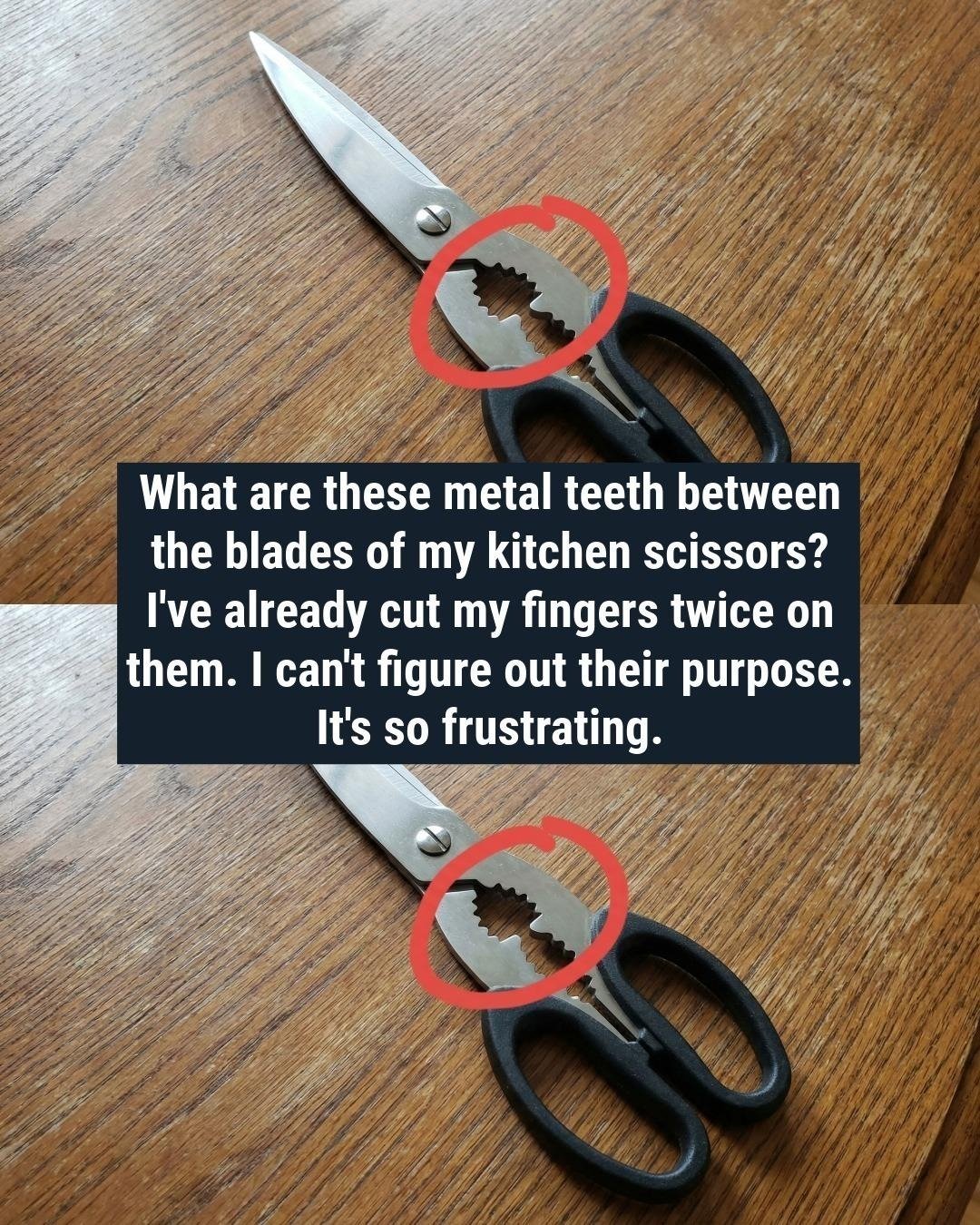
What Is That Weird Toothed Part on Kitchen Scissors For?
You’ve probably held a pair of kitchen scissors thousands of times. You’ve used them to cut herbs, open packaging, trim meat, snip twine, or break down food packaging when a knife felt like overkill.
But there’s a part of kitchen scissors that almost everyone notices — and almost everyone ignores.
That strange toothed, jagged, often round or oval section between the handles.
You’ve seen it.
You may have squeezed it once or twice out of curiosity.
You may have assumed it was decorative, or just there for grip.
But it turns out, that “weird” toothed part is actually one of the most useful features on kitchen scissors — and most people are using it completely wrong… or not using it at all.
Once you know what it’s for, you’ll never look at your scissors the same way again.
The Part Everyone Notices but Nobody Understands
Unlike regular office scissors, kitchen scissors are built differently. They’re thicker, sturdier, and designed for tasks beyond cutting paper or tape.
And right in the middle — usually near the pivot point — there’s that toothed section.
It might look like:
A set of interlocking grooves
A small circular opening with ridges
A jagged, textured clamp
It doesn’t look sharp.
It doesn’t look intuitive.
And it doesn’t come with instructions.
So most people just… ignore it.
But that’s a missed opportunity.
The Short Answer: It’s a Built-In Multi-Tool
That toothed section isn’t random.
It’s designed to act as a gripping, crushing, cracking, and twisting tool — essentially turning your scissors into a mini kitchen multi-tool.
Depending on the design, that section can be used to:
Crack nuts and shells
Open stubborn jars or bottle caps
Grip slippery food items
Break apart small bones or cartilage
Hold items steady while cutting
In other words: it’s there to give you leverage and control — not cutting power.
Why Kitchen Scissors Have It (and Regular Scissors Don’t)
Office scissors are made for light, repetitive cutting.
Kitchen scissors are made for force.
That toothed area exists because many kitchen tasks require:
Grip instead of slicing
Pressure instead of sharpness
Stability instead of precision
Knives aren’t always safe or effective for those jobs, and fingers definitely aren’t.
So designers added a section that lets you clamp down hard without slipping.
One of Its Most Common Uses: Cracking Nuts and Shells
One of the original and most common purposes of that toothed part is cracking hard shells.
Think:
Walnuts
Pecans
Hazelnuts
Even crab or lobster shells (light duty)
Instead of reaching for a nutcracker, you can:
Place the nut between the toothed jaws
Squeeze the handles slowly and firmly
Let the grooves grip and crack the shell
Because the teeth interlock, the nut doesn’t shoot out the way it might with smooth surfaces.
Opening Stubborn Jars and Bottle Caps
Ever struggled with a jar that just won’t open?
That toothed section can help.
The grooves are designed to:
Increase friction
Prevent slipping
Apply even pressure
You can use it to:
Twist metal bottle caps
Grip plastic seals
Break vacuum seals on jars
It’s especially helpful when:
Your hands are wet
A lid is greasy
You don’t have a jar opener nearby
Handling Slippery or Awkward Foods Safely
Some foods are notoriously hard to grip with fingers alone.
Examples:
Chicken skin
Fish bones
Sausages
Small vegetables
The toothed section allows you to hold food firmly without piercing it or crushing it completely.
This is especially useful when:
Trimming meat
Cutting poultry
Removing skin or fat
Stabilizing food while slicing
It gives you control without putting your fingers at risk.
