
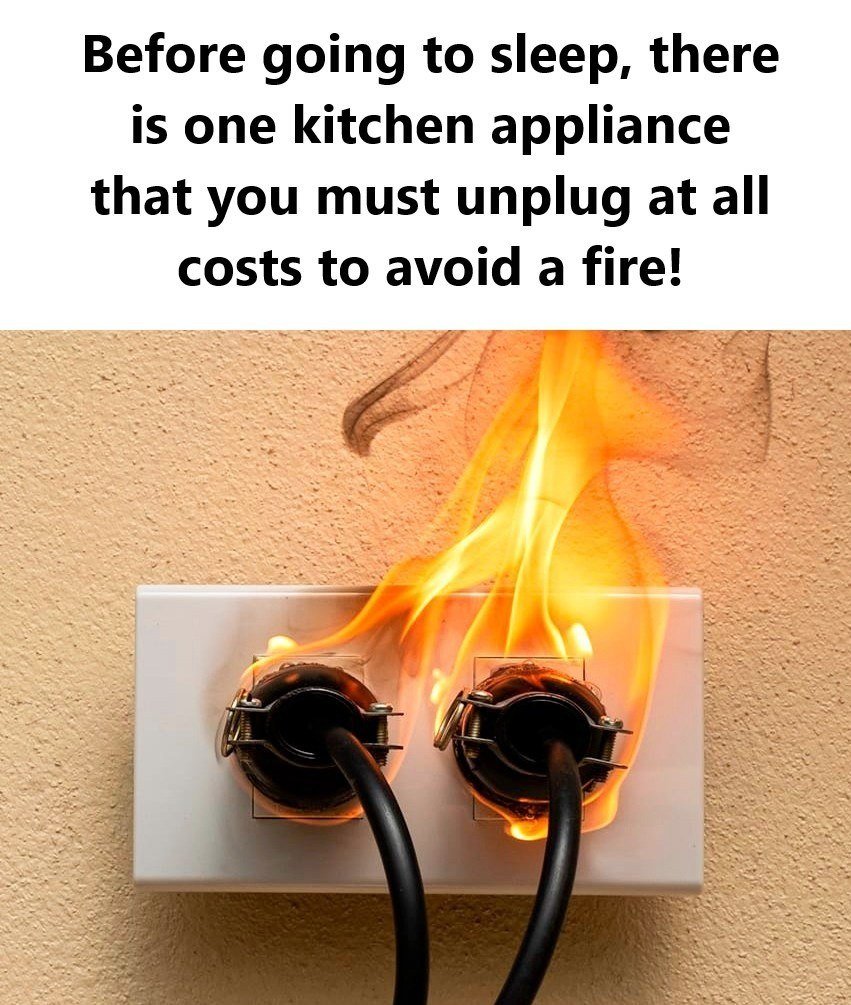
Most people believe that house fires are caused by dramatic accidents: unattended candles, faulty wiring, or open flames. What many don’t realize is that one of the most common fire risks is sitting quietly on the kitchen counter, plugged in, seemingly harmless—often left that way overnight.
Fire safety experts repeatedly warn that a single habit could significantly reduce the risk of nighttime house fires:
Unplugging certain kitchen appliances before going to sleep.
This is not about fear. It’s about awareness. Because many kitchen appliances continue drawing electricity even when they are “off,” and some are far more dangerous than people realize.
This article explains:
Which kitchen appliance poses the greatest risk
Why leaving it plugged in overnight can be dangerous
How fires start while people are asleep
Who is most at risk
What fire investigators often find after accidents
Simple habits that can protect your home and family
The Appliance Most Experts Warn About: The Toaster (and Similar Heating Devices)
If there is one kitchen appliance that fire safety professionals consistently recommend unplugging at night, it is the toaster—along with similar small heating appliances such as toaster ovens, sandwich makers, and electric grills.
These appliances may seem harmless, but they combine several high-risk factors:
Internal heating elements
Crumbs or food residue
Mechanical components
Electrical current even when idle
Together, these create the perfect conditions for an overnight fire.
Why the Toaster Is More Dangerous Than You Think
1. It Contains Exposed Heating Elements
Unlike many appliances, toasters rely on bare heating coils that reach extremely high temperatures.
Even when the toaster is not actively in use:
Residual heat can remain
Electrical faults can activate coils
Internal wiring can spark
2. Crumbs Accumulate Inside
Over time, crumbs collect at the bottom of the toaster. These crumbs are:
Dry
Highly flammable
Often ignored during cleaning
A single electrical spark can ignite them.
3. Mechanical Failure Can Occur Without Warning
Toasters contain springs, levers, and timers. If one component fails:
The heating element may stay on
The toaster may overheat
There may be no visible sign until smoke appears
This is especially dangerous at night when no one is awake to smell or see early warning signs.
How Kitchen Fires Start While People Are Sleeping
Nighttime fires are especially deadly—not because they are more intense, but because they are detected later.
When you’re asleep:
Your sense of smell is reduced
You can’t see smoke
Reaction time is delayed
Fires have more time to spread
An appliance that sparks at 2 a.m. can turn a small flame into a major fire before anyone wakes up.
“But My Toaster Is Turned Off”
This is one of the most common misconceptions.
Many appliances:
Still draw power when plugged in
Are affected by power surges
Can short-circuit due to aging wires
Turning an appliance “off” does not always disconnect it from electricity.
Unplugging it does.
Fire Investigators See This Pattern Again and Again
In many kitchen fire investigations, reports show:
No active cooking
No candles
No human error at the time of ignition
Instead, they often find:
A small appliance plugged in
Signs of electrical malfunction
Evidence of heat buildup
Toasters, toaster ovens, and similar appliances are frequently listed among the sources.
