
To most people, the bookstore was probably just another shop tucked away on a quiet street. But for me, it was something more.
There was nothing glamorous about it—just dusty shelves, worn wooden floors, and the comforting scent of old books. Yet somehow, it felt like a refuge. Everything had its place, and every day followed the same predictable rhythm.
Most shifts passed without anything memorable happening. Customers came in searching for obscure titles, I pointed them toward the right shelf, and life moved on.
Then one Tuesday changed everything.
A teenage girl walked into the store. She looked about sixteen or seventeen, wearing a hoodie and carrying an oversized backpack that seemed far too heavy for her small frame. At first, I paid little attention. But after a while, I noticed something unusual.
She wasn’t browsing.
She was searching.
While pretending to organize paperwork, I watched her from across the store. She moved quickly through the aisles until she found a particular book. She pulled it from the shelf, hesitated for a moment, then slipped it into her backpack.
I’ve seen shoplifters before. Some are nervous. Others act overly confident. This girl was neither.
She looked empty.
She didn’t check for cameras. She didn’t glance around to see if anyone was watching. She simply took the book and stood there as if nothing mattered.
I approached her carefully.
“Hey,” I said.
She turned toward me.
Instead of running, she froze.
Then she burst into tears.
Instantly, any confidence I had disappeared. I felt awful just standing there.
Trying to stay calm, I said, “You know you can’t do that, right?”
She barely seemed to hear me.
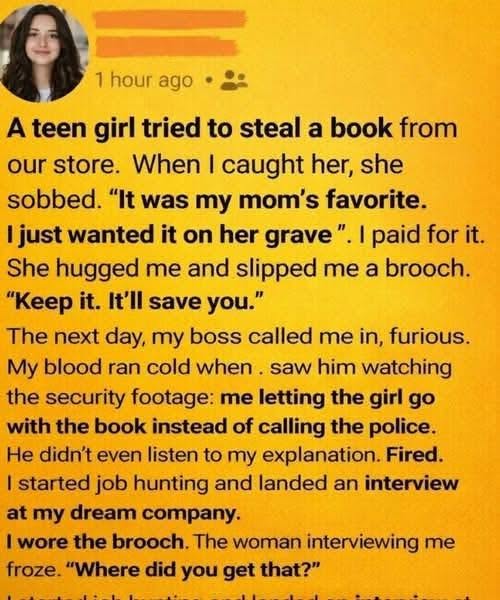
Through her sobs, she explained that her mother had died the previous year. The book she’d taken wasn’t random—it had been her mother’s favorite. More importantly, it was the exact copy they had once read together.
She wanted to leave it at her mother’s grave as a final goodbye.
But she didn’t have the money to buy it.
At that moment, company policies stopped mattering.
I walked back to the register, fully aware that security cameras were recording every move. Then I pulled out my credit card and paid for the book myself.
Twenty-two dollars and some change.
Three hours of work.
It felt like the only choice I could make.
When I handed the book to her, she stared at me as if I had given her the world.
Without saying a word, she threw her arms around me in a tight hug.
Then she pressed something into my hand.
“It was her lucky one,” she whispered. “It’ll save you. I promise.”
When I looked down, I saw a silver flower brooch. It was old, slightly tarnished, and surprisingly heavy.
I tried to return it.
But before I could say anything, she was already gone.
The next morning unfolded exactly as I feared.
My manager, Rick, was waiting for me before I even clocked in. Security footage from the previous day was already playing on his screen.
He didn’t yell.
He simply recited company policies and explained how my actions violated store procedures.
Then he handed me my final paycheck.
Just like that, I was unemployed.
Walking out of the bookstore felt surreal. I’d lost a stable job because I followed my conscience and helped a stranger.
For days, I wondered whether I’d made a terrible mistake.
A week later, I found myself sitting in the lobby of a prestigious design firm, waiting for an interview I was certain I wasn’t qualified for.
I wore my only decent blazer.
For reasons I still can’t explain, I pinned the silver flower brooch to the lapel.
Maybe I hoped it would bring me luck.
The interview started normally until the woman across the desk suddenly stopped speaking.
Her eyes were fixed on the brooch.
“Where did you get that?” she asked.
My stomach dropped.
I told her the truth.
Instead of ending the interview, she stood up and asked me to follow her.
Moments later, I entered a large corner office where an older man stood staring out a window.
When he turned around and saw the brooch, the color drained from his face.
He stepped closer, his eyes locked on the silver flower.
“Where is she?” he asked quietly.
Then he asked again.
And again.
Eventually, I learned the truth.
The brooch had been handmade for his late wife. After her death, their daughter, Elena, struggled to cope with the loss. Her grief spiraled out of control. She disappeared from home, cut off contact with her family, and effectively vanished.
The brooch had disappeared with her.
For months, her father had no idea where she was or whether she was even safe.
Then I walked into his office wearing the one item he never expected to see again.
Suddenly, my worries about unemployment felt insignificant compared to what this family had endured.
I told him everything.
I described Elena, the bookstore encounter, her tears, and the book she wanted to leave at her mother’s grave.
When I mentioned the cemetery, something changed in him.
For the first time, he had a lead.
“You saw her,” he kept saying. “You actually saw her.”
Today, I work at that design firm.
The older man, Arthur, hired me despite my lack of experience. He said he’d rather employ someone who genuinely cares about people than someone with a flawless résumé.
The job comes with benefits, opportunities, and a future I never imagined for myself.
Even better, Elena is back home.
Her healing journey isn’t over, but she’s no longer alone.
A few months after I started, I tried returning the brooch to Arthur.
He refused.
In his family, there’s a belief that certain possessions find the people they’re meant to find.
According to him, the brooch chose me.
I still don’t know whether I believe in fate, luck, or destiny.
What I do know is this:
The twenty-two dollars I spent on that book turned out to be the best investment of my life.
I still touch the brooch whenever I’m nervous before a meeting. It reminds me that kindness isn’t weakness.
Sometimes, doing the right thing comes with a price.
But every now and then, life finds a way to repay it in ways you never could have imagined.
And although I occasionally miss the quiet aisles and familiar scent of that old bookstore, I wouldn’t change a single thing.
