
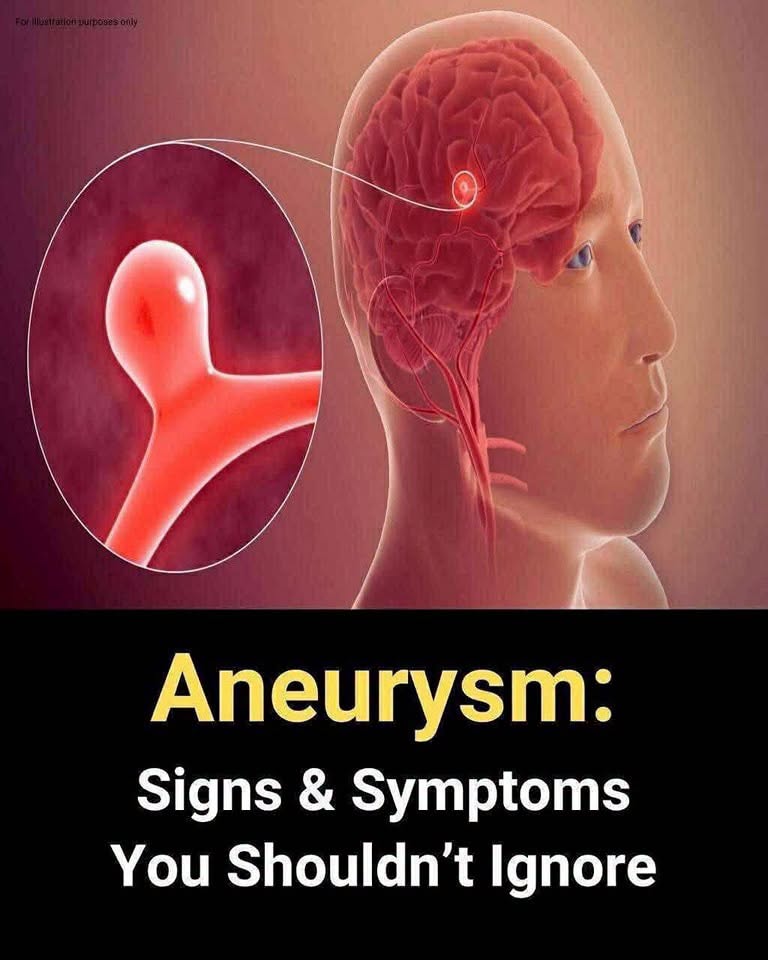
A brain aneurysm is a silent but potentially deadly condition. It occurs when a weakened blood vessel in the brain balloons outward, creating pressure—or, in the worst case, rupturing and causing life-threatening bleeding.
[adinserter block=”5″]
The danger? Most aneurysms cause no symptoms at all until it’s too late.
But medical experts emphasize this crucial truth: When warning signs do appear, recognizing them could save a life.
I learned this the hard way. A friend once dismissed a “weird headache” and blurred vision as stress. Days later, she was in the ER with a ruptured aneurysm. She survived—but not without lasting effects. Her story stays with me.
You don’t need to live in fear. But you do need to know what to watch for.
Here are 12 signs that may signal a brain aneurysm—and exactly what to do if you notice them.
🚨 The 12 Warning Signs (Never Ignore These)
1. Sudden, Severe Headache
Often called “the worst headache of my life,” this explosive pain comes on without warning—like a thunderclap. It’s the most common sign of a ruptured aneurysm.
🆘 Action: Seek emergency care immediately. Do not wait.
2. Nausea and Vomiting
When paired with a sudden headache, these can signal increased pressure in the skull from bleeding or swelling.
🆘 Action: Don’t assume it’s “just a stomach bug” if neurological symptoms are present.
3. Blurred or Double Vision:
3. Blurred or Double Vision
Pressure from an aneurysm near the optic nerves can cause visual disturbances—suddenly seeing double, blurred images, or loss of vision in one eye.
🆘 Action: Report sudden vision changes to a doctor same day.
4. Stiff or Painful Neck
A rigid neck—especially with headache or fever—can indicate bleeding irritating the meninges (brain/spinal cord membranes).
🆘 Action: If neck stiffness appears suddenly with other symptoms, go to the ER.
5. Sensitivity to Light (Photophobia)
Unusual discomfort or pain in bright light can signal brain irritation from bleeding or pressure.
🆘 Action: Note this symptom alongside others—it adds to the clinical picture.
6. Drooping Eyelid or Dilated Pupil
An aneurysm pressing on cranial nerves can cause one eyelid to droop or one pupil to enlarge unexpectedly.
🆘 Action: Sudden facial/eye changes = urgent evaluation.
7. Seizures
New-onset seizures in adults can be triggered by aneurysm-related bleeding or pressure on brain tissue.
🆘 Action: Any first-time seizure requires immediate medical attention.
8. Loss of Consciousness
[adinserter block=”6″]
Fainting, blacking out, or sudden confusion can indicate significant bleeding or brain involvement.
🆘 Action: Call 911. Do not drive yourself.
9. Trouble Speaking or Understanding Speech
Slurred words, confusion, or inability to comprehend language may signal a neurological event like stroke or aneurysm rupture.
🆘 Action: Use the FAST test: Face drooping? Arm weakness? Speech difficulty? Time to call 911.
10. Difficulty Walking, Dizziness, or Loss of Balance
Sudden coordination problems can mean an aneurysm is affecting brain areas controlling movement.
🆘 Action: Don’t dismiss “just feeling off”—sudden neurological changes need evaluation.
11. Pain Behind or Around One Eye
An unruptured aneurysm near the eye socket can cause localized, persistent pain due to nerve pressure.
🆘 Action: Report new, unexplained eye pain—especially with vision changes.
12. Personality or Behavioral Changes
Confusion, mood swings, memory lapses, or uncharacteristic behavior can occur if an aneurysm affects frontal brain regions.
🆘 Action: Sudden cognitive/emotional shifts warrant medical review.
⚠️ Critical Distinction: Unruptured vs. Ruptured
| Unruptured Aneurysm | Ruptured Aneurysm |
|---|---|
| May cause no symptoms or mild warnings (eye pain, vision changes) | Causes sudden, severe symptoms (thunderclap headache, loss of consciousness) |
| Often found incidentally during imaging for other issues | Medical emergency—requires immediate intervention |
| Treatment: Monitoring, coiling, or clipping to prevent rupture | Treatment: Emergency surgery + intensive care to limit damage |
💡 Key insight: Many aneurysms are discovered before rupture during scans for unrelated issues. If you have risk factors (family history, smoking, high blood pressure), ask your doctor about screening.
🩺 Who’s at Higher Risk?
While anyone can develop an aneurysm, risk increases with:
- Family history of brain aneurysms
- Smoking or heavy alcohol use
- High blood pressure (hypertension)
- Age (most common in adults 40–60)
- Certain conditions: Polycystic kidney disease, connective tissue disorders
- Head trauma or drug use (especially cocaine)
🌟 Good news: Managing blood pressure, quitting smoking, and limiting alcohol significantly reduce risk.
🆘 When to Seek Emergency Care
Call 911 or go to the ER immediately if you or someone else experiences:
✅ Sudden, severe headache (“worst ever”)
✅ Headache + vomiting, stiff neck, or vision changes
✅ Loss of consciousness, seizure, or confusion
✅ Slurred speech, facial drooping, or weakness on one side
⏱️ Remember: “Time is brain.” Every minute counts when bleeding occurs in the brain.
🔍 How Aneurysms Are Diagnosed
If an aneurysm is suspected, doctors may use:
- CT scan: Quick detection of bleeding
- CT angiogram or MR angiogram: Detailed images of blood vessels
- Cerebral angiogram: Gold standard for mapping aneurysm size/location
These tools allow specialists to plan treatment before rupture—or act fast if one has occurred.
❤️ Final Thoughts: Awareness Is Power
A brain aneurysm doesn’t always give warning. But when it does, your awareness could be the difference between life and loss.
You don’t need to memorize every detail. Just remember this:
Sudden + severe + neurological = Get help NOW.
Trust your instincts. Advocate for yourself. And if something feels deeply wrong, don’t wait for permission to seek care.
Because your brain—and your life—are worth it.
🧠 Share this with someone you love. You never know when knowing these signs could save a life.
If you’re experiencing symptoms, please contact emergency services immediately. This article is for educational purposes only and not a substitute for professional medical advice
[adinserter block=”7″]