
[adinserter block=”4″]
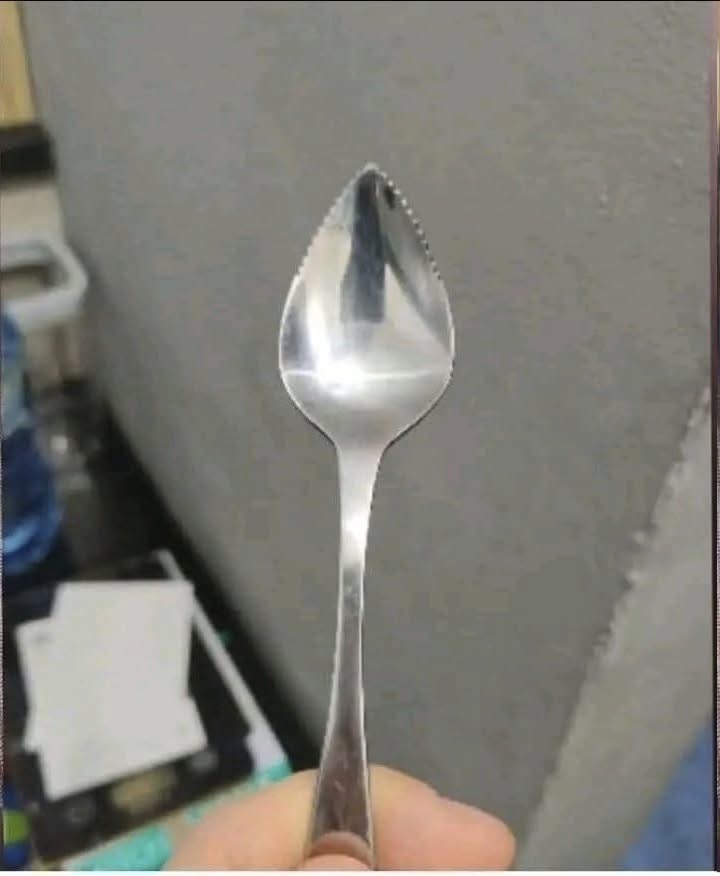
You’re unpacking the kitchen drawer in a new rental, rummaging through inherited cutlery, or sorting through a box of old utensils — and there it is. A spoon that looks almost normal at first glance, but something is off. The tip is pointed like a leaf. The edges along the bowl are lined with tiny, sharp little teeth — like a miniature saw built into the sides of a teaspoon.
It doesn’t look broken. It doesn’t look like a medical tool. It’s clearly deliberate, clearly well-made, and clearly designed to do something specific.
So what is it?
It’s a Grapefruit Spoon — and It’s Genius
That pointy, ridged utensil is a grapefruit spoon — also commonly called a citrus spoon, orange spoon, fruit spoon, or by its French name, pamplemousse spoon. It was designed in the 1920s specifically to solve one of the most frustrating breakfast problems of the era: eating a halved grapefruit without spraying juice everywhere, shredding the segments, or ending up with sticky fingers and a mess on the table.
The design has remained essentially unchanged for a hundred years — because it doesn’t need to be. It’s a perfect tool.
Why Does a Spoon Need Serrated Edges?
The answer lies in the anatomy of citrus fruit.
Grapefruits, oranges, pomelos, and similar citrus fruits don’t just contain flesh. They contain flesh organized into individual segments, each one wrapped in a thin but tough membrane. Between these segments and the outer rind is another layer of white pith that holds everything together.
A regular spoon slides right off these membranes. It can’t cut through them, which means using an ordinary teaspoon to eat a halved grapefruit results in tearing, squirting juice, and leaving half the fruit behind in the rind. A knife can separate the segments, but requires separate tools and multiple steps.
The grapefruit spoon solves both problems simultaneously. The serrated edges function as miniature saws — when you run the side of the spoon along the inside of the rind or against a membrane, the tiny teeth cut cleanly through it in a single stroke. The pointed tip allows you to pierce and separate segments precisely at the membrane lines without dragging or tearing.
The result is clean, neat, effortless fruit eating with a single utensil. Each segment lifts out whole, the juice stays in the bowl, and the rind is left completely clean.
How to Use a Grapefruit Spoon Correctly
The technique is simple once you understand what the tool is doing:
Step 1 — Cut the fruit in half. Slice your grapefruit, orange, or similar fruit crosswise — cutting around the equator rather than through the stem ends — so you have two equal halves facing up.
Step 2 — Pierce the membrane. Insert the pointed tip of the spoon between two adjacent segments, pressing it down through the membrane to the bottom of the fruit. This initial pierce is what allows the serrated edge to work freely.
Step 3 — Run along the rind. Position the spoon bowl along the curved inside edge of the rind and push it downward, keeping the serrated side pressed against the boundary between flesh and rind. The teeth cut cleanly through the connecting tissue and free the flesh from the peel.
Step 4 — Separate the segments. Use the serrated side edge to cut along the membrane between each pair of segments. The saw-like motion of the spoon cuts through the membrane cleanly, and the bowl of the spoon scoops the freed segment straight up and into your mouth.
Step 5 — Scoop and enjoy. Each segment lifts out cleanly, fully intact. The rind and membranes stay behind in the bowl. No mess, no squirting, no frustration.
Once you’ve used this technique two or three times it becomes completely instinctive — and eating a halved citrus fruit becomes genuinely effortless.
What Else Can You Use a Grapefruit Spoon For?
Here’s the part that surprises most people: once you understand what the serrated edge can do, you’ll find reasons to reach for this spoon constantly — even if you never eat grapefruit.
Kiwifruit: Cut a kiwi in half lengthwise, then use the grapefruit spoon to scoop the flesh cleanly away from the skin in one smooth motion. The serrated edge cuts through the slight resistance where flesh meets skin perfectly. It’s dramatically faster than peeling and slicing.
Cantaloupe and honeydew melon: Cut a melon in half and use the grapefruit spoon to scrape out the seed cavity cleanly and quickly. The serrated edge removes every last fibrous strand far more efficiently than a regular spoon.
Avocado: Halve an avocado, remove the pit, and use the grapefruit spoon to separate the flesh from the skin in a single clean sweep. The result is smooth, intact avocado halves with no torn skin and no wasted flesh left behind.
Butternut squash and pumpkin: The serrated bowl scrapes seeds and stringy fibers from the interior of winter squashes in seconds — doing in one pass what takes multiple scoopings with a regular spoon.
Tomatoes: When a recipe calls for seeded tomatoes, the grapefruit spoon scoops seed cores out cleanly without damaging the flesh walls.
Mangoes: Score a mango half and use the grapefruit spoon to scoop the cubed flesh away from the skin with minimal waste.
Eggshell retrieval: If a piece of eggshell falls into a bowl of raw egg, the sharp tip of a grapefruit spoon gets underneath the shell fragment and lifts it out cleanly — far more effectively than chasing it with a finger.
Strawberry hulling: The sharp, pointed tip of a grapefruit spoon works as a precise strawberry huller — cutting around and removing the green top and tough core without wasting fruit.
Chocolate shavings: Run the serrated edge along the flat side of a block of chocolate to create thin, delicate shavings for garnishing desserts, cakes, and hot drinks.
Desserts: The pointed tip and serrated edge are excellent for getting into parfait glasses, digging through layered desserts, crème brûlée, custards, and anything with a firm top layer that a regular spoon would slide over.
What Are the Different Designs?
[adinserter block=”5″]
Not all grapefruit spoons look exactly the same, and understanding the two main design variations helps you use whichever version you find:
Pointed tip with serrated sides — the most common design. The tip is sharply pointed like a leaf and both side edges of the spoon bowl carry small teeth. This design excels at piercing membranes precisely and separating segments cleanly.
Blunt front edge with serrated sides — a variation where the front of the bowl is blunt or rounded but the side edges carry the serrations. This design is used by pushing the rounded front edge into the fruit to create a channel, then using the serrated sides to cut laterally along the membrane. Some people find this design gentler for soft fruits.
Both designs achieve the same result through slightly different techniques. If you’ve found one in a drawer, either version works beautifully for all the applications described above.
A Tool That’s Been Around for 100 Years — and Still Perfect
The grapefruit spoon was invented in the 1920s when grapefruit became fashionable in American breakfast culture, popularized partly by the grapefruit diet trends of that era. The challenge of eating the fruit elegantly at a breakfast table without tools designed for the job spawned this simple, brilliant solution.
The design was patented, widely sold as part of premium cutlery sets, and became a standard item in well-equipped kitchens throughout the mid-20th century. As citrus eating habits shifted and formal breakfast service became less common, the spoons became less prominent in mainstream kitchery — but they never disappeared. They turn up in inherited cutlery collections, thrift stores sold as “citrus spoons” for almost nothing, and kitchen drawers in rentals and older homes everywhere.
Modern versions are still manufactured today in stainless steel, matte black, gold finish, and longer-handled versions designed for tall parfait glasses and sundae cups. The design hasn’t meaningfully changed in a century because there has never been a reason to change it.
Should You Keep It or Throw It Out?
Keep it. Absolutely keep it.
The grapefruit spoon is one of those rare kitchen tools that earns its drawer space every single week across multiple applications — even if you never use it for grapefruit specifically. Once you start using one for kiwis, avocados, melons, and scooping squash seeds, you’ll wonder how you managed without it.
If anything, find a second one. And if you enjoy eating citrus fruits regularly, this is one of the kitchen items most worth deliberately owning rather than accidentally inheriting.
[adinserter block=”3″]