

[adinserter block=”7″]
Drivers had dealt with headlight glare for decades by flipping a manual tab that changed the mirror angle. The tab worked, but required the driver to notice the glare and take action every time bright lights appeared behind them. Gentex Corporation automated this process in 1982 by connecting light sensors to a small motor that tilted the mirror when glare appeared. These electromechanical mirrors became optional equipment in luxury cars by 1983.
The motor system solved the glare problem, but the mechanical parts made it expensive and prone to failure. Engineers kept searching for more reliable ways to help the public drive safely at night and avoid accidents.
A father and son team of chemists brought Gentex the answer. They had developed an electrochromic gel that darkens when electricity flows through it and clears when the current stops. Gentex spent years refining a way to sandwich a thin gel layer between two pieces of glass. Sensors mounted on the mirror housing could now trigger an electrical charge that darkened the gel instantly, with no moving parts.
The first electrochromic mirror appeared in the 1988 Lincoln Continental. Eight GM models added the feature in 1989, and the technology spread through the industry during the early 1990s. Donnelly Corporation developed similar technology and tried to compete. Gentex sued them for patent violations in 1990, starting a legal battle that lasted through the decade. Both companies survived and kept making mirrors, but Gentex maintained the dominant position.
The Design Flaw That Ruined Interiors
Success bred competition, but competition bred problems. Magna Donnelly manufactured most automatic mirrors between the late 1990s and mid-2000s with seal materials that couldn’t withstand years of exposure to the gel and temperature cycling. The seals eventually broke down, and where they broke determined how fast the gel escaped.
Top breaches took weeks before bubbles or dark spots appeared as air seeped through. Bottom breaches started dripping the same day because gravity pulled the gel straight down through the opening. Sometimes the dimming function quits before any visible damage shows, leaving the mirror stuck dark or unable to dim at all. Once the gel escaped, it ate through the plastic trim and paint. Some owners found it pouring onto their center console without warning.
BMW moved all mirror production to Gentex in 2007 after warranty claims stacked up. Other manufacturers followed because Gentex had fixed the seal problem with better materials and manufacturing processes. Gentex now supplies about 85% of automatic mirrors worldwide, so most cars built after 2010 avoid this failure.
Cars from those problem years still exist. Any mirror showing gel bubbles or dimming issues needs removal before the liquid escapes and damages interior parts that cost far more than the replacement mirror itself.
The One Maintenance Tip Worth Remembering
Modern mirrors avoid the catastrophic seal failures that plagued older models, but dimming mirrors need regular cleaning to work properly. Fingerprints and skin oils scatter light in random directions, turning what should be a clear, dimmed view into a blurry mess.
Manual mirrors show this fastest because they reflect from the front glass surface in night mode. A single fingerprint creates a bright spot, and the oils attract dust between cleanings. Automatic mirrors face the same issue when touched during adjustments.
The trick is cleaning without causing damage. Ammonia-based glass cleaners attack the silvering until it separates from the glass, leaving permanent dark spots. Water or mild glass cleaner made for mirrors removes oils without attacking the coating.
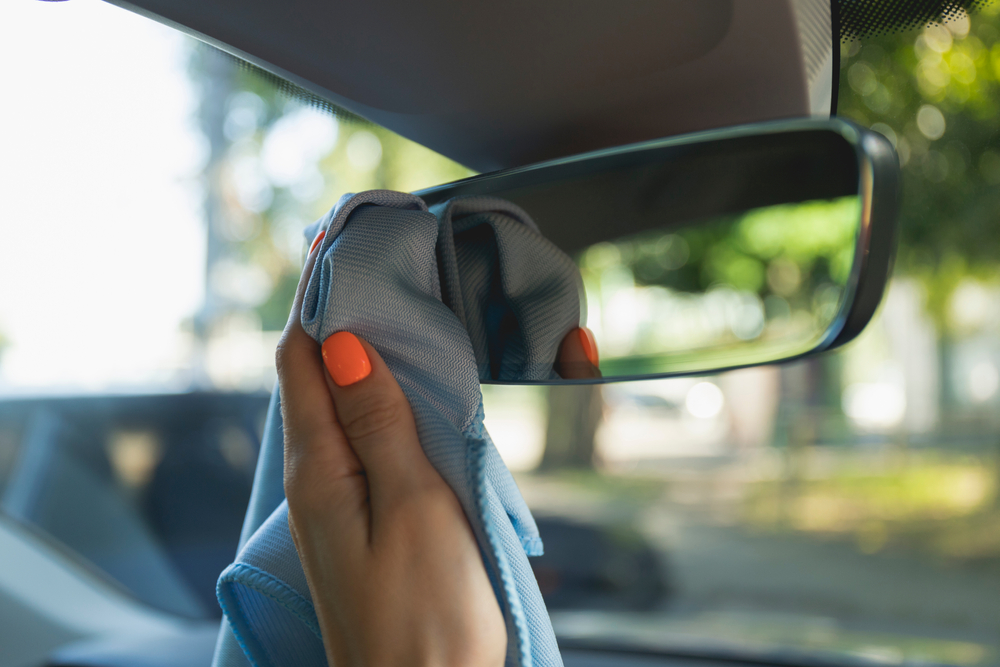
Spray the cleaner on a microfiber cloth rather than directly on the mirror so liquid cannot seep behind the glass and corrode the electrical connections. Wipe in straight lines instead of circles to avoid streaks. Clean every few weeks, more often with frequent adjustments. Grab the housing or mounting arm when repositioning to avoid touching the glass in the first place.
A smeared mirror defeats the purpose of every night driving tip here, so keep the glass clean, and the dimming will work when bright lights hit during your night drive.
[adinserter block=”7″]