
When to Switch Back at Night
[adinserter block=”6″]
Most drivers flip the tab once and forget it exists. Some leave it dimmed all day and ruin their visibility for no reason. Others never touch it and squint through glare. One simple driving tip when driving at night is to flip the tab based on what you see, not what time it is. Street lights and well-lit roads provide enough ambient light that dimming becomes unnecessary, so save it for dark country roads and highways where the contrast between darkness and bright headlights creates the worst glare.
Lane changes feel wrong at first because distances look off. The adjustment takes a few trips, but modern LED and HID headlights can be blinding for several seconds. The slight distortion beats losing vision when switching lanes.
The National Highway Traffic Safety Administration received over 4,000 public comments about headlight glare in 2001, more responses than any other safety concern that year. The problem hasn’t gone away. Headlights shifted from halogen to LED and HID technology, which made them brighter and more likely to cause glare. An online petition asking Congress to regulate these lights has collected over 50,000 signatures because more vehicles now use high-mounted lights that shine directly into rearview mirrors.
When Driving Dimmed Becomes Dangerous
The dimmed mirror helps on dark highways but fails in parking lots. Flip it back to day mode before backing up because the reduced brightness makes distances harder to judge. Shopping carts and concrete barriers can vanish entirely, so a routine backup turns risky.
Parallel parking demands the same precision. You need to see exactly where the curb sits and how close the car behind you is, but the dimmed reflection makes these judgments nearly impossible. Parking garages with their concrete pillars and tight spaces create the same problem, so flip the mirror back before you maneuver.
Don’t forget to switch back each morning. Driving with the dimmed mirror during daylight cuts your awareness of surrounding traffic, which makes lane changes riskier when you need clear views of cars behind you.
Electrochromic Mirrors Automate This
Flipping the tab forward at night and back each morning adds one more task to remember. Forget once while backing up, and you might hit a shopping cart that vanished in the dimmed reflection, so automatic mirrors handle the job for you.

American inventor Jacob Rabinow developed the first light-sensitive automatic mechanism for car rearview mirrors in the 1950s, earning a patent reported in a 1961 New York Times article. The device used a photocell to detect glare from headlights and automatically dimmed the mirror by tilting it with motors. But mechanical systems wear out, which pushed later inventors toward electronic solutions.
Gentex Corporation solved this problem in 1986 with electrochromic dimming, which became the best solution for driving after dark because the car mirror settings adjusted smoothly without mechanical parts. The technology uses a gel layer sandwiched between two pieces of glass that darkens when voltage flows through it. This means the mirror dims silently and adjusts to any brightness level instead of just two fixed positions.
Sensors control when the gel darkens. A forward sensor measures ambient light while a rear sensor watches for headlight glare behind you. When the rear sensor spots a bright light, it sends a voltage to the gel layer. The gel darkens in proportion to how bright those headlights are, so the dimming adjusts continuously as cars get closer or farther away. The mirror clears back to normal when the lights disappear.
These systems became standard on many mid-range vehicles by the 2010s as production costs fell. Side mirrors often use the same technology, dimming all three together. The rearview mirror tells the side mirrors when and how much to dim.
How to Know If Yours Is Automatic
Look for a tab or lever at the bottom of the mirror. If you don’t see one, the mirror uses automatic dimming because manual mirrors always have that mechanical switch.

Automatic mirrors have a small LED on the face that glows green or amber. The indicator shows the system has power, and it usually sits near the bottom edge of the glass. Some mirrors display AUTO when the feature runs.
Test the system by shining a flashlight at the mirror from behind your seat. The glass should darken gradually within a few seconds. If nothing happens, check the owner’s manual because some systems include an off switch or require activation through vehicle settings.
Most automatic systems let you adjust how aggressively they dim. Some vehicles bury this setting in the dashboard screen, while others put a button directly on the mirror. Adjusting the sensitivity ranks among the most useful night driving tips because factory settings don’t match every driver’s preference.
Older automatic mirrors sometimes fail when the gel degrades or sensors die. The mirror might stay dark permanently, ignore bright lights entirely, or dim inconsistently. Replacement costs depend on what else the mirror includes, so a basic auto-dimming mirror costs less than one with a compass display or garage door opener built in.
Buttons Instead of Tabs on Some Models
Some manufacturers add a motor to manual dimming controls. This design appears on certain European luxury brands like BMW and Mercedes, and some Lexus models. Press the button and the motor tilts the mirror between day and night positions. The button sits where a flip tab would normally be and makes a quiet whirring sound as the motor adjusts the angle. The change takes about a second. The button sometimes includes an LED that shows which mode is active.
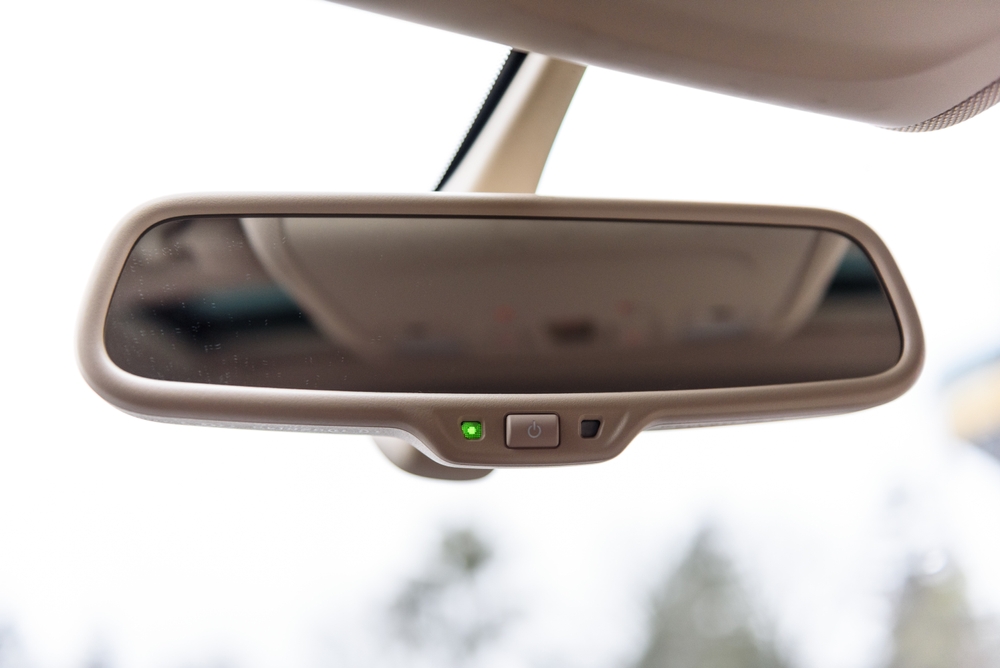
The motorized button tilts the mirror just like a flip tab does, but a motor handles the work instead of finger pressure. This means the driver still decides when glare becomes a problem and presses the button to dim. Automatic mirrors eliminate this decision because sensors detect the glare and dim on their own.
How Automatic Mirrors Came to Exist
[adinserter block=”6″]